Run the OR better. Manage the whole episode. Prove the savings.
Anesthesia-led perioperative performance: one platform for the operating rooms, every step of the surgical episode, and a value program whose savings a hospital CFO can check line by line.
Discussion draft · September 2026 · Prepared by the founding team with the clinical partner · Synthetic data only
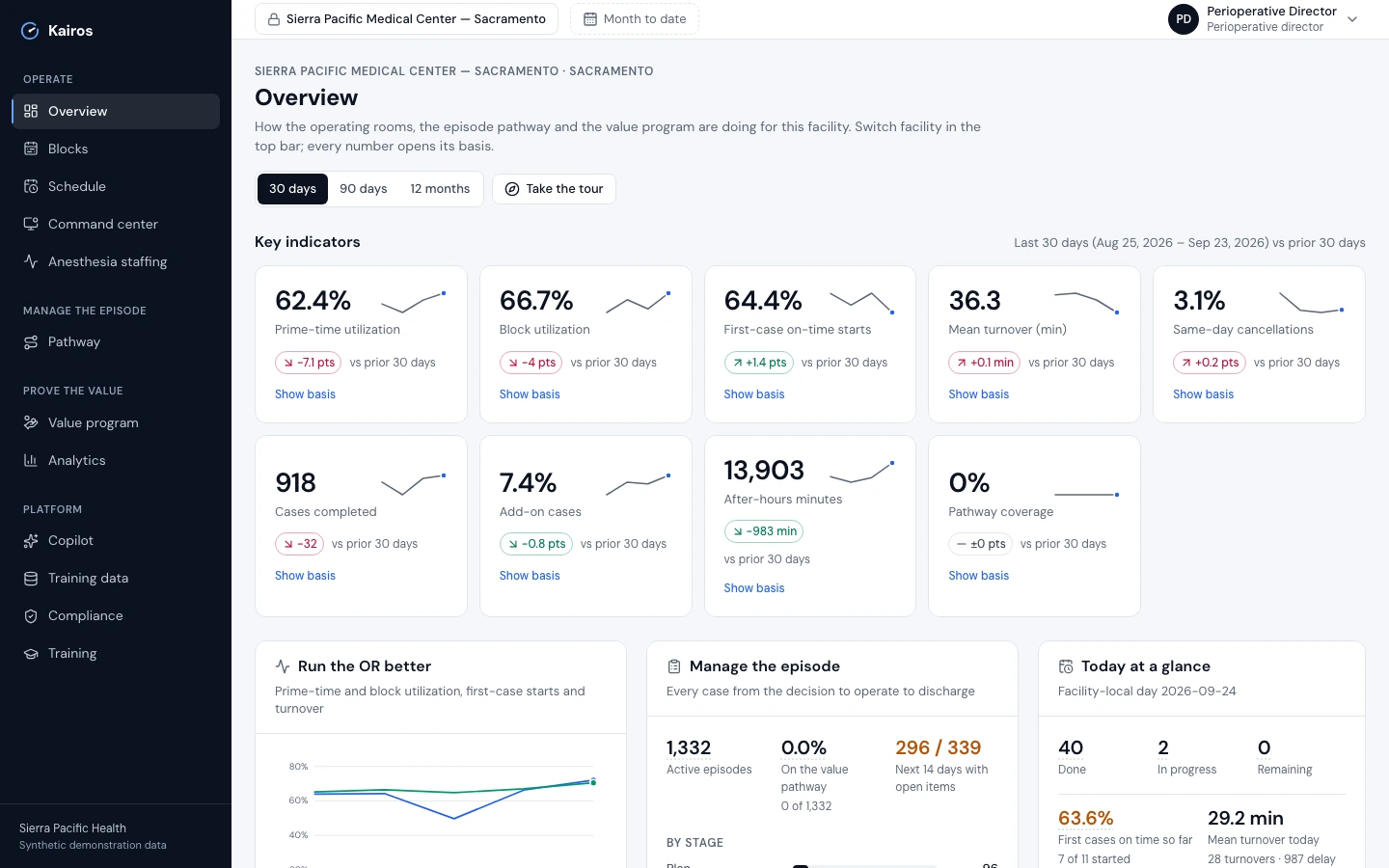
Kairos · OverviewThe Overview, signed in as a perioperative director. Every tile opens the arithmetic behind it.
Kairos (working name) · Discussion draft · September 2026 · Synthetic data only
Why this matters
02 / 19
Surgical care is where cost, risk and capacity meet
The perioperative pathway touches almost every hospital cost line — OR minutes, beds, complications, readmissions — yet it is managed one slot at a time.
~1/3
of U.S. healthcare spending is associated with surgical care
Per the clinical partner’s framework
28–32%
of the global burden of disease is attributable to conditions requiring surgical care
Per the clinical partner’s framework
Risk is discovered too late
Anemia, diabetes, sleep apnea and anticoagulation are too often found on the day of surgery — when the only options are delay, cancel or proceed with more risk.
Incentives are fragmented
Surgeons, anesthesia, the hospital and the payer each optimize their own piece. Nobody is paid to own the whole episode, from the decision to operate to the discharge.
Savings are claimed, not proven
Tools report recovered minutes or projected dollars. A CFO, a surgeon and a payer rarely see the same arithmetic — so shared savings stall at validation.
“I need an AI software that cuts down the cost all around and shows the savings.”
The clinical partner — an anesthesiologist who owns hospitals and clinics in California
Surgical-care share of spending and of the global burden of disease: as cited in the clinical partner's framework (Farm to OR Table deck, 2026). Quote: the clinical partner, September 2026.
Kairos (working name) · Discussion draft · September 2026 · Synthetic data only
The incentive gap
03 / 19
Hourly staffing pays for presence, not pathway performance
The team best placed to change the episode — anesthesia, which sees every patient before, during and after surgery — is paid the same whether the pathway works or not.
1
Today: hourly staffing
Pays for hours covered — the same whether a case was cancelled, ran late or went home early.
2
Base salary
Protects safety and recruitment.
3
Value incentive
Target 15–20% of base, capped, paid on the balanced scorecard.
4
Share of validated savings
Only after clinical and finance validation. Both value components are zero when the safety gate fails.
The proposed model
1
Base
A competitive base protects safety and recruitment. It never depends on volume.
2
Quality and access incentive
A defined upside — target 15–20% of base, capped — paid on a five-domain, risk-adjusted scorecard. No single-metric payment.
3
Validated savings share
A defined share of savings that passed clinical review, then finance review. Nothing is shared before validation.
Safety gate. Any period that misses a minimum safety threshold pays no value component at all — enforced by the software, not a policy PDF.
Compensation model: docs/PRODUCT-VISION.md and docs/VALUE-ENGINES.md §7. The demo's seeded plan (anesthesiologist base $480k, target 17.5%, cap 25%; 30% of validated savings shared) is illustrative.
Kairos (working name) · Discussion draft · September 2026 · Synthetic data only
Farm to OR Table
04 / 19
One accountable team follows the patient through five stages
The clinical partner’s model, made operational: every case sits on a pathway from the decision to operate through discharge, and every stage feeds the scorecard.
1Plan
Risk screen at scheduling
Kairos does
Risk tier with its basis at the moment of booking
Duration prediction P50 / P75 / P90
Block, open-time and slot finder
2Prepare
Optimize, test by protocol
Kairos does
Open optimization items: anemia, diabetes, smoking, frailty, OSA, anticoagulation
Each test and consult flagged indicated or not indicated per protocol
3Deliver
ERAS, safe anesthesia, reliable starts
Kairos does
Live command center: first-case starts, turnover, delays
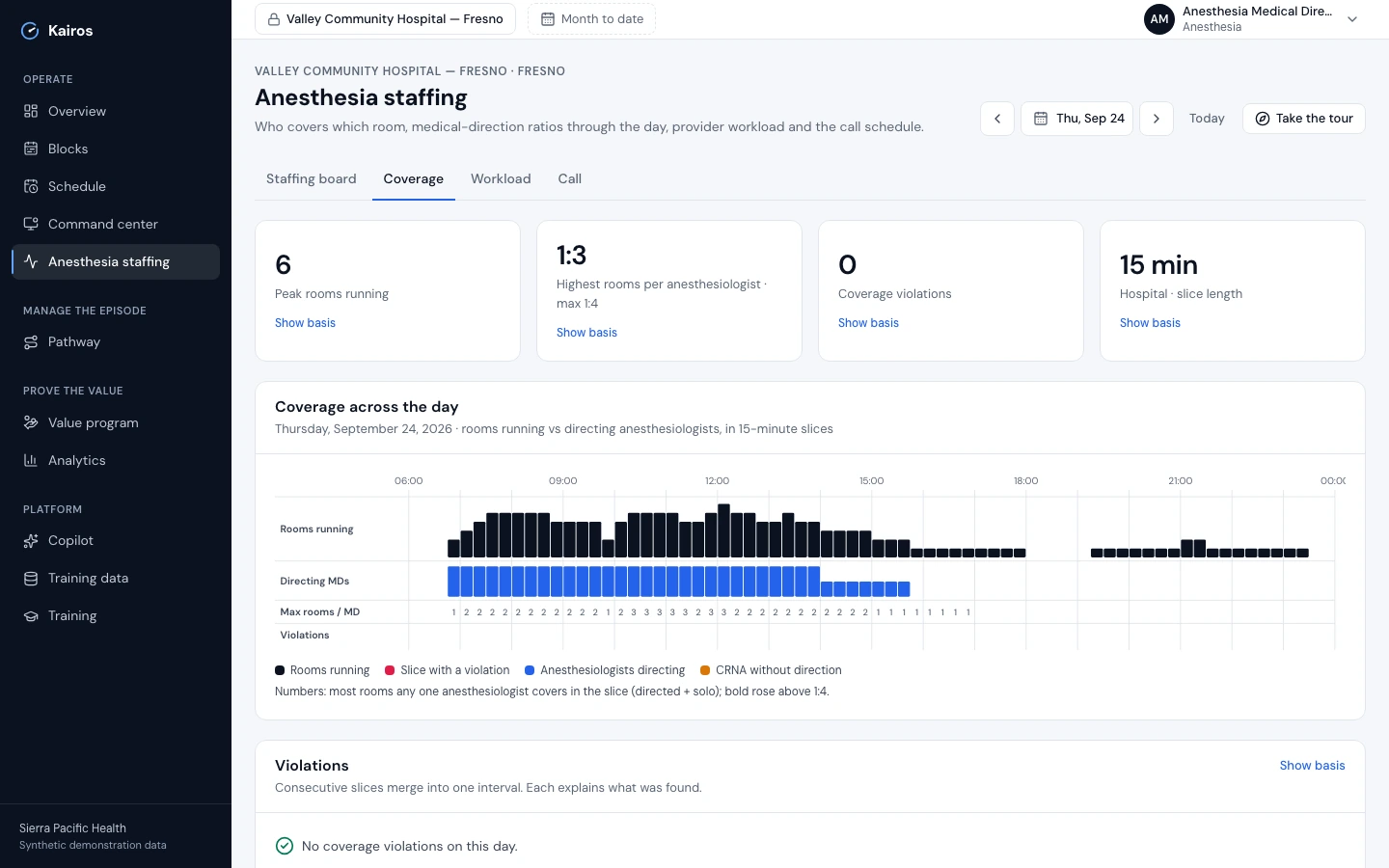
Anesthesia coverage and 1:4 medical direction in 15-minute slices
ERAS elements tracked
4Recover
Analgesia, prevent complications
Kairos does
DVT/PE, reintubation, kidney injury, severe PONV
Opioid exposure (MME) per inpatient case
Risk-adjusted length of stay
5Transition
Discharge planned before surgery
Kairos does
Discharge destination set pre-op
30-day readmission and ED-visit windows
Episode closes into the scorecard
Measured end to endBalanced scorecard with safety gateSavings ledger with the arithmetic on every lineCompensation statements for the team
Stages: the clinical partner's Farm to OR Table model (docs/PRODUCT-VISION.md). What Kairos does at each stage: docs/VALUE-ENGINES.md §10 and docs/OPERATIONS-MODULES.md.
Kairos (working name) · Discussion draft · September 2026 · Synthetic data only
Positioning
05 / 19
Why this is bigger than block scheduling
Block-scheduling tools optimize one lever and sell it to the periop director. Kairos treats OR utilization as one of five levers — and still does that lever well, deterministically and with its basis shown.
Unit of optimization
Block-scheduling tools: OR block minutes
Kairos: The surgical episode, from the decision to operate to recovery
Buyer
Block-scheduling tools: Perioperative director
Kairos: Health system and anesthesia partnership, under a value contract
Economic story
Block-scheduling tools: Recovered OR capacity
Kairos: Validated episode savings, shared with the clinical team
Clinical scope
Block-scheduling tools: Scheduling
Kairos: Risk screening, optimization, testing stewardship, ERAS, recovery and discharge
Incentive alignment
Block-scheduling tools: None
Kairos: Scorecard-driven compensation: base, bonus and a share of validated savings
AI
Block-scheduling tools: Predictive scheduling
Kairos: Predictive scheduling and a copilot over the whole episode — briefs, recommendations, savings narratives
Block-scheduling tools compared with Kairos
Dimension
Block-scheduling tools
Kairos
Unit of optimization
OR block minutes
The surgical episode, from the decision to operate to recovery
Buyer
Perioperative director
Health system and anesthesia partnership, under a value contract
Economic story
Recovered OR capacity
Validated episode savings, shared with the clinical team
Clinical scope
Scheduling
Risk screening, optimization, testing stewardship, ERAS, recovery and discharge
Incentive alignment
None
Scorecard-driven compensation: base, bonus and a share of validated savings
AI
Predictive scheduling
Predictive scheduling and a copilot over the whole episode — briefs, recommendations, savings narratives
The buyer is the partnership that can change the episode, not only the office that allocates blocks.
The economic story ends in validated dollars with a basis — not a projection.
Multi-facility, multi-organization tenancy from day one: the second hospital is configuration.
Comparison: docs/PRODUCT-VISION.md, generalized to the block-scheduling tool category.
Kairos (working name) · Discussion draft · September 2026 · Synthetic data only
The product · lever 1 of 5 · Run the OR better
06 / 19
Release the time owners will not use, and book cases for how long they really take
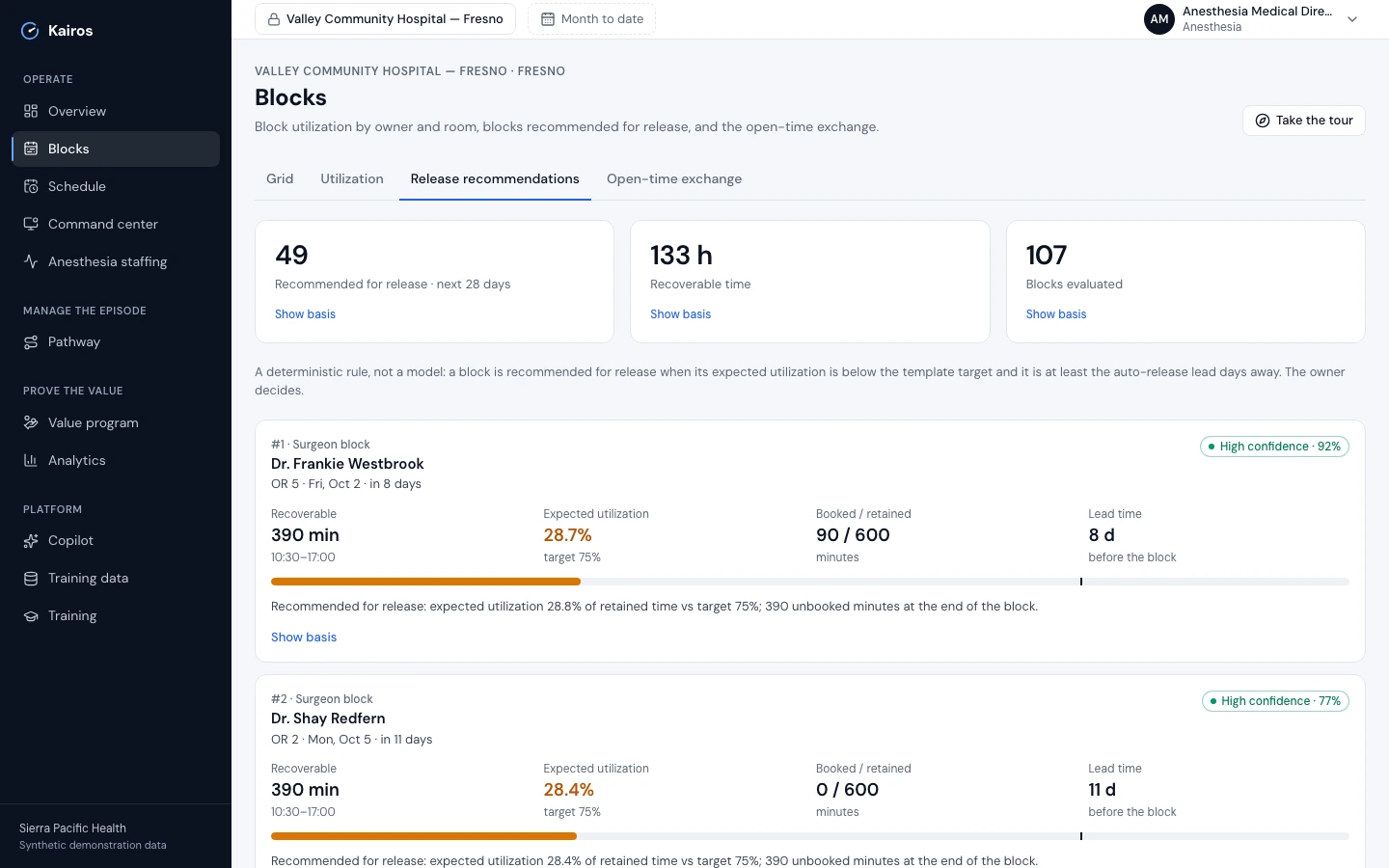
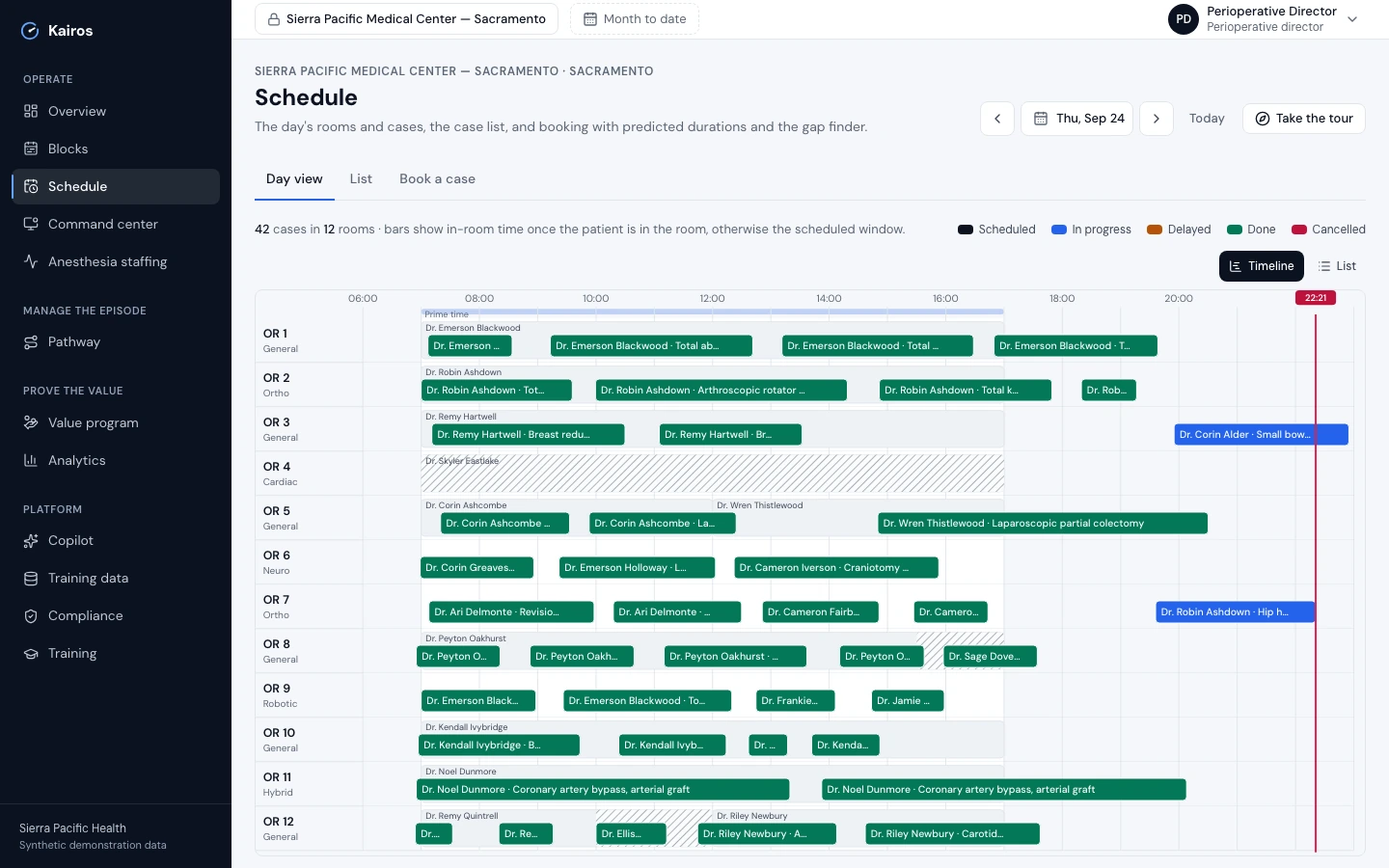
Blocks · Release recommendations49 blocks, 7,980 minutes recommended for release at the pilot hospital over the next 28 days — a deterministic rule with its basis; the owner decides.Schedule · Day viewThe day view: 42 cases in 12 rooms, block bands, prime time and a live now line. Booking shows P50/P75/P90 predictions and the database itself rejects a double booking.
Block utilization per owner, raw and adjusted, with a weekday × hour heatmap.
Release recommendations ranked by recoverable minutes, from the owner’s trailing utilization and the facility’s booking curve.
An open-time exchange, and duration predictions that beat surgeons’ own estimates.
Synthetic data · fictional health system
Blocks → Release recommendations, Valley Community Hospital, next 28 days as of Sep 24, 2026. Schedule: Sierra Pacific Medical Center day view, Sep 24, 2026. Demo script minutes 2–4.
Kairos (working name) · Discussion draft · September 2026 · Synthetic data only
The product · lever 1 of 5 · Run the OR better
07 / 19
Run the day from one screen — including anesthesia coverage
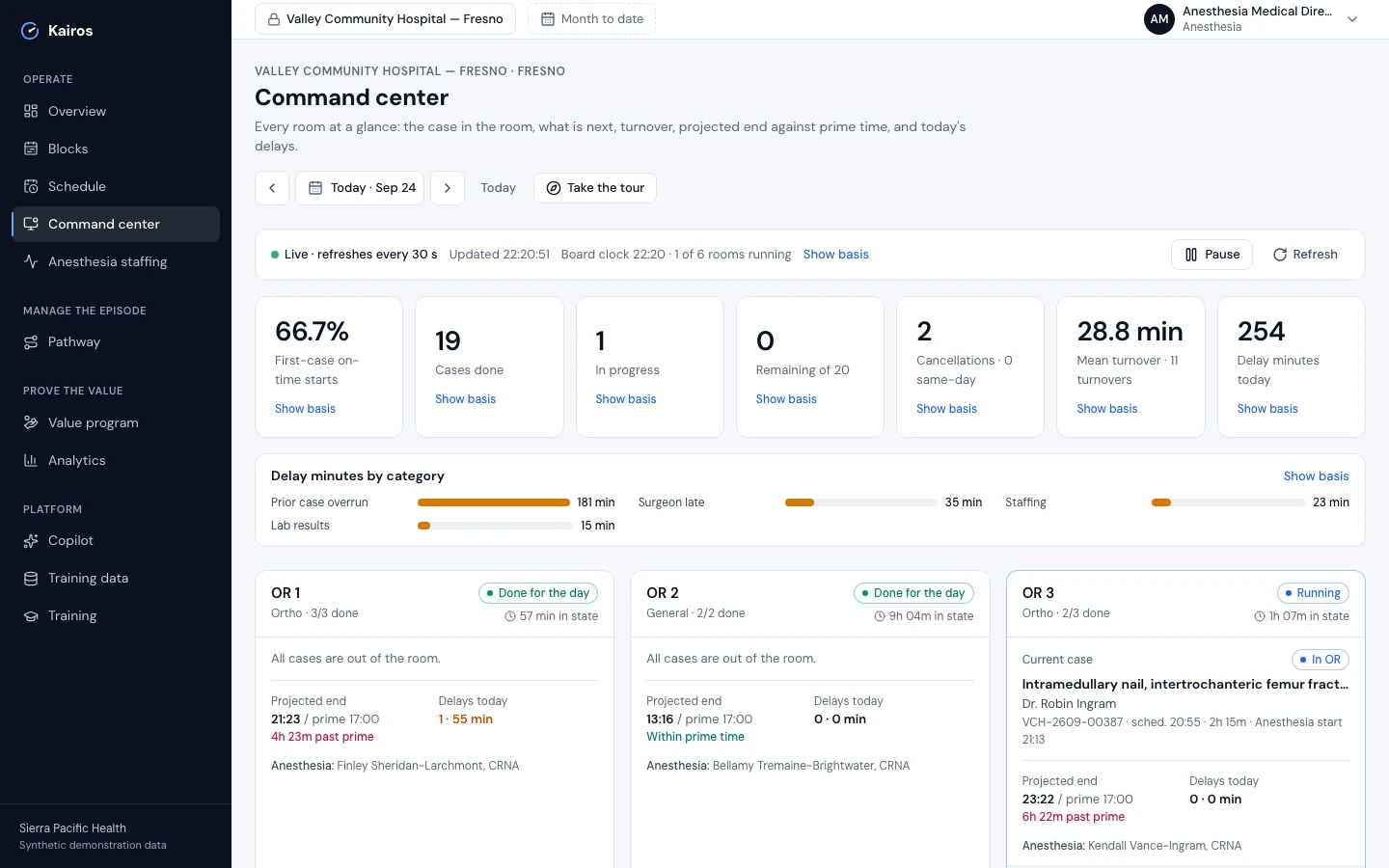
Command centerThe live board: every room’s current case, projected end against prime time, delays by category, turnover and first-case starts.Anesthesia staffing · CoverageCoverage in 15-minute slices: rooms running against directing anesthesiologists, the 1:4 medical-direction ratio, and every flagged interval with its basis.
Record milestones as they happen; delays carry a reason.
Anesthesia staffing is a first-class module, not an afterthought.
The same numbers roll into the reliability domain of the scorecard.
Synthetic data · fictional health system
Command center and Anesthesia → Coverage at Valley Community Hospital, Sep 24, 2026 (signed in as the anesthesia medical director). Demo script minutes 4–6.
Kairos (working name) · Discussion draft · September 2026 · Synthetic data only
The product · lever 2 of 5 · Manage the whole episode
08 / 19
The team manages the episode, not just the slot
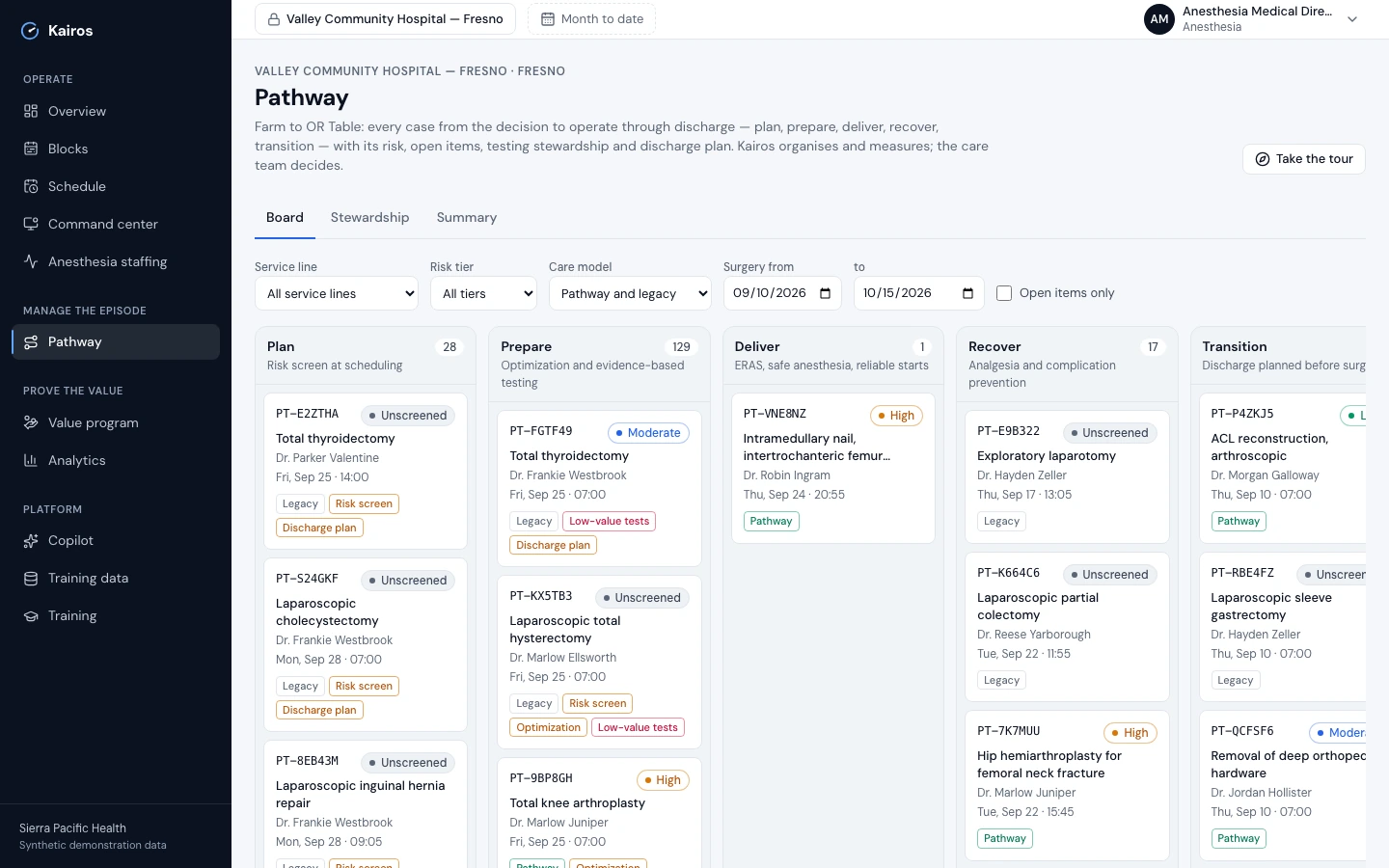
Every upcoming case sits on a PLAN → TRANSITION board with its risk tier, open optimization items, testing-stewardship flags and discharge plan — weeks before the day of surgery, when there is still time to act.
Risk screen at scheduling: a score with its basis, never a clinical conclusion.
Tests and consults marked indicated or not indicated per protocol; only non-indicated ones count as avoidable.
ERAS elements, complications and the discharge destination tracked per episode.
Pathway versus legacy care side by side, so the before/after is visible per service line.
Software organizes, measures and drafts; clinicians decide.
Synthetic data · fictional health system
Pathway · BoardFarm to OR Table as a working board: stage, risk tier and open items on every card.
Pathway board at Valley Community Hospital, surgeries Sep 10 – Oct 15, 2026. Stewardship rule: docs/VALUE-ENGINES.md §9–10. Demo script minutes 6–7.
Kairos (working name) · Discussion draft · September 2026 · Synthetic data only
The product · lever 3 of 5 · Prove the value
09 / 19
Scorecard with a safety gate → savings with their basis → what the team earns
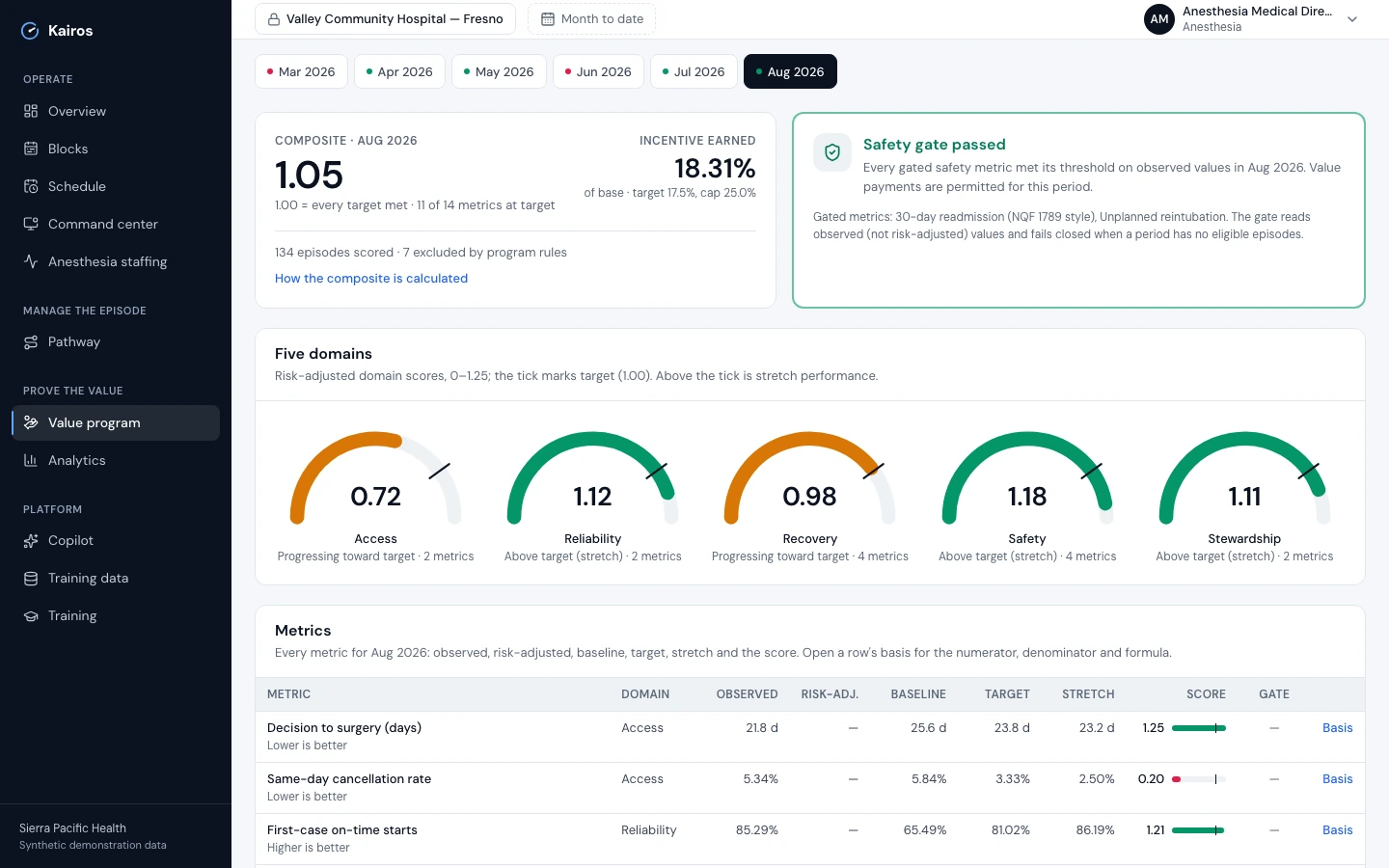
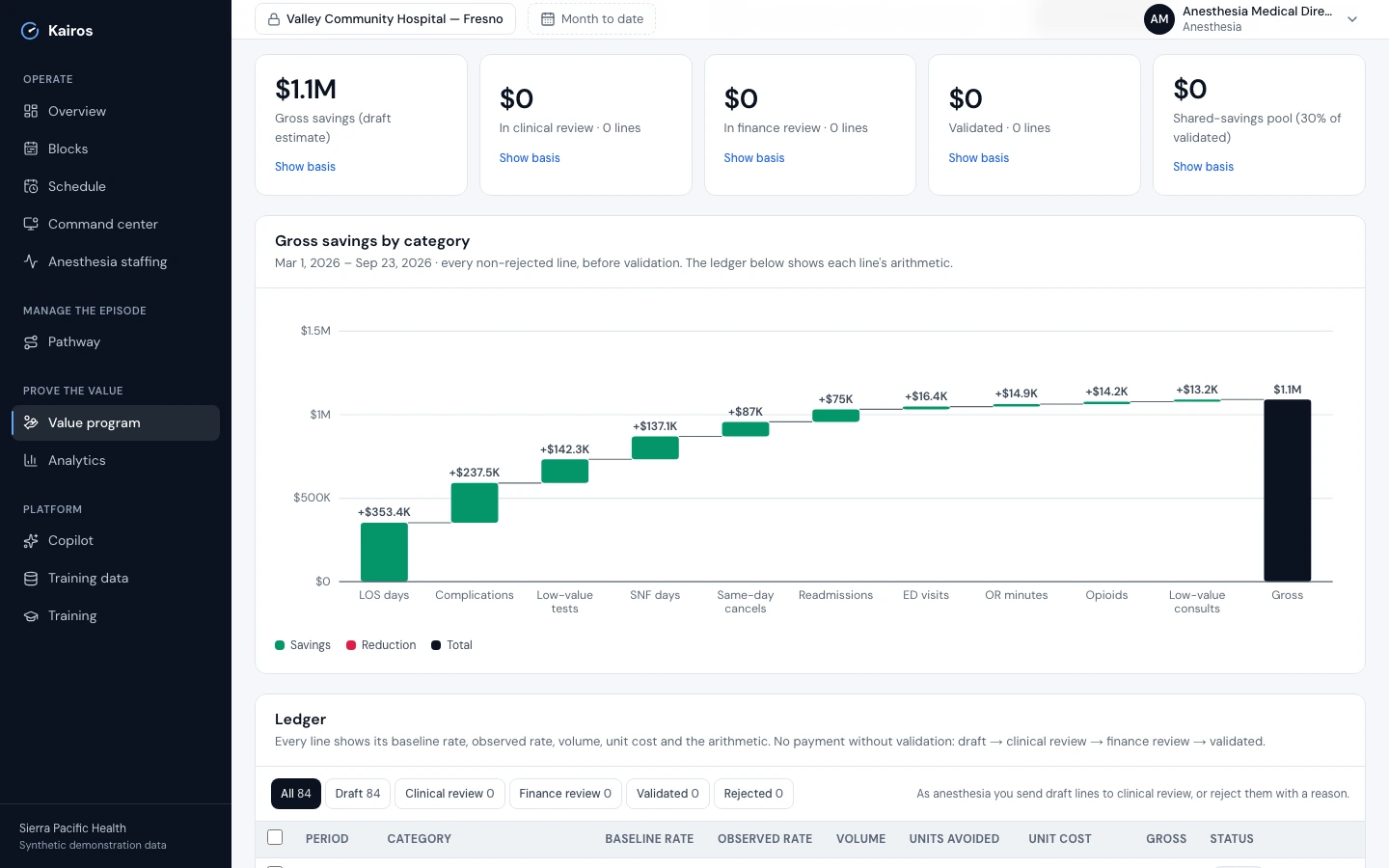
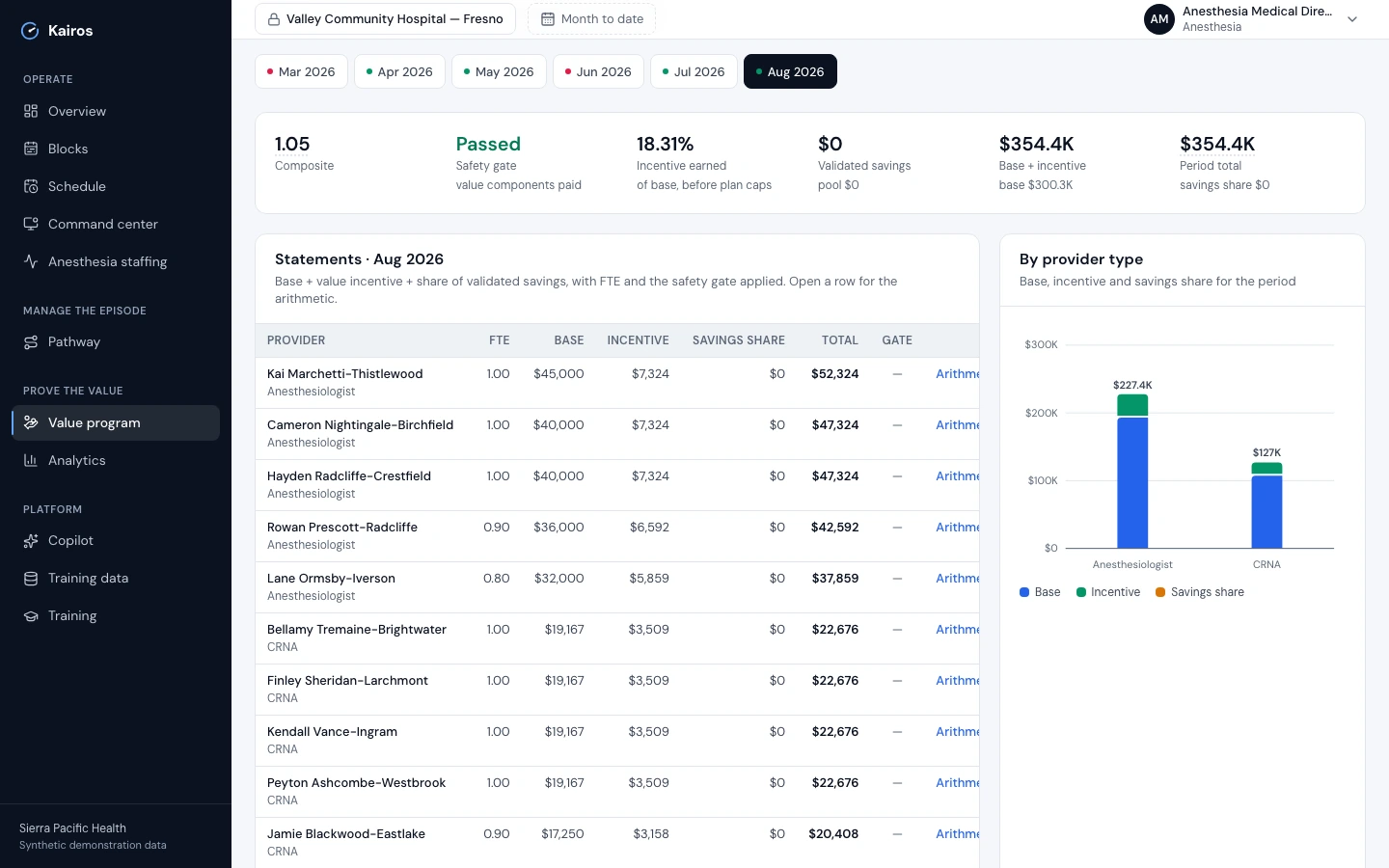
Value program · ScorecardComposite 1.05, gate passed, 11 of 14 metrics at target — five risk-adjusted domains, no single-metric payment.Value program · Savings ledger$1.09M gross, $0 validated — every line shows baseline rate × volume × unit cost, and nothing counts until clinical and finance review.Value program · CompensationStatements per provider: base + incentive + savings share, with FTE, the gate and the arithmetic one click away.
Safety gate fails closed: no eligible episodes means no value payment.
Validation needs two different people: clinical review, then finance review.
The program cannot activate until counsel approves the gainsharing design.
Synthetic data · fictional health system
Value program → Scorecard, Aug 2026, Valley Community Orthopedics pilot (synthetic); Value program → Savings ledger, Mar 1 – Sep 23, 2026, all lines in draft; Value program → Compensation, Aug 2026, Valley Community anesthesia team. Demo script minutes 7–8.5.
Kairos (working name) · Discussion draft · September 2026 · Synthetic data only
The product · lever 4 of 5 · Claude across all of it
10 / 19
Claude over the live data — with guardrails you can see
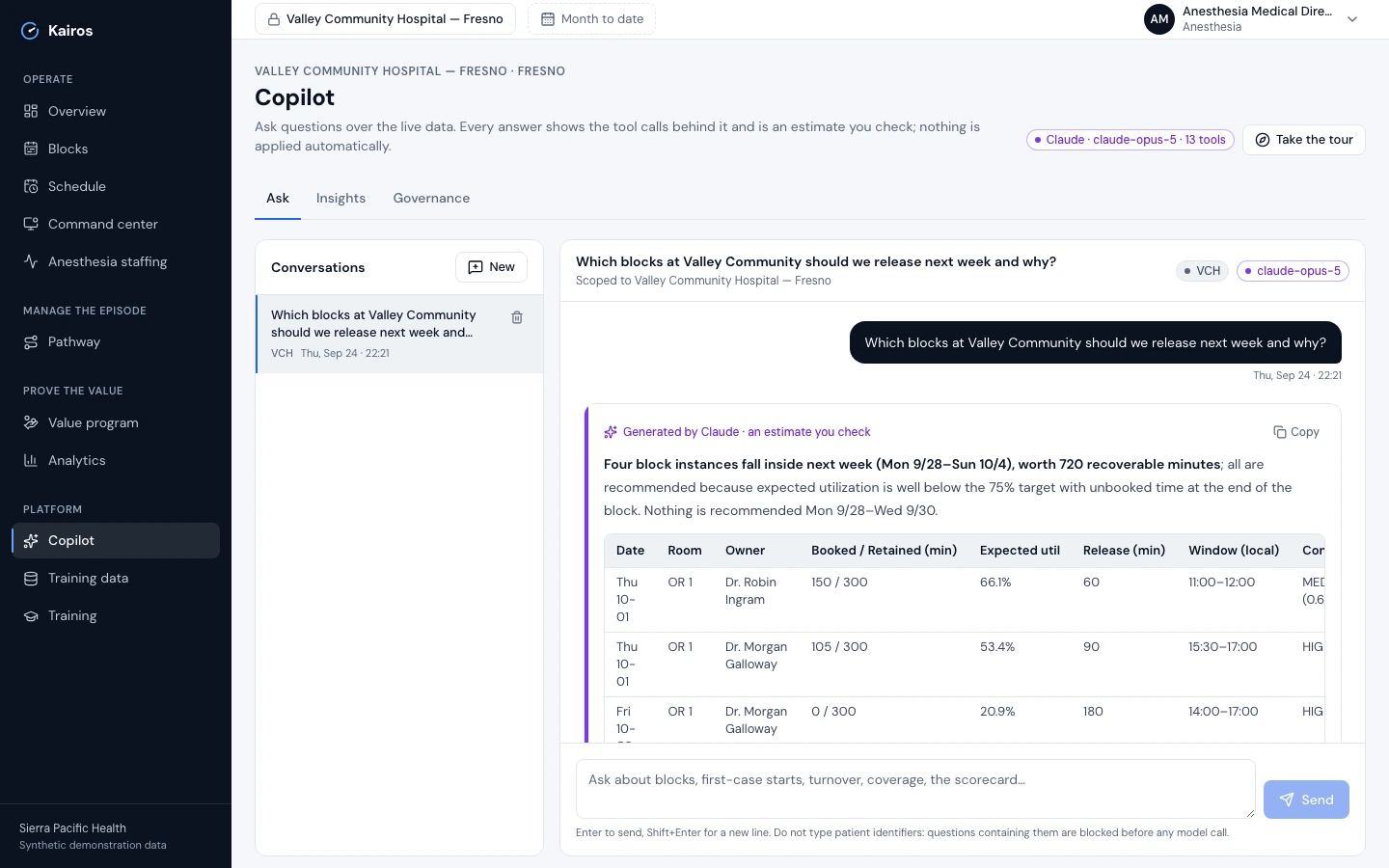
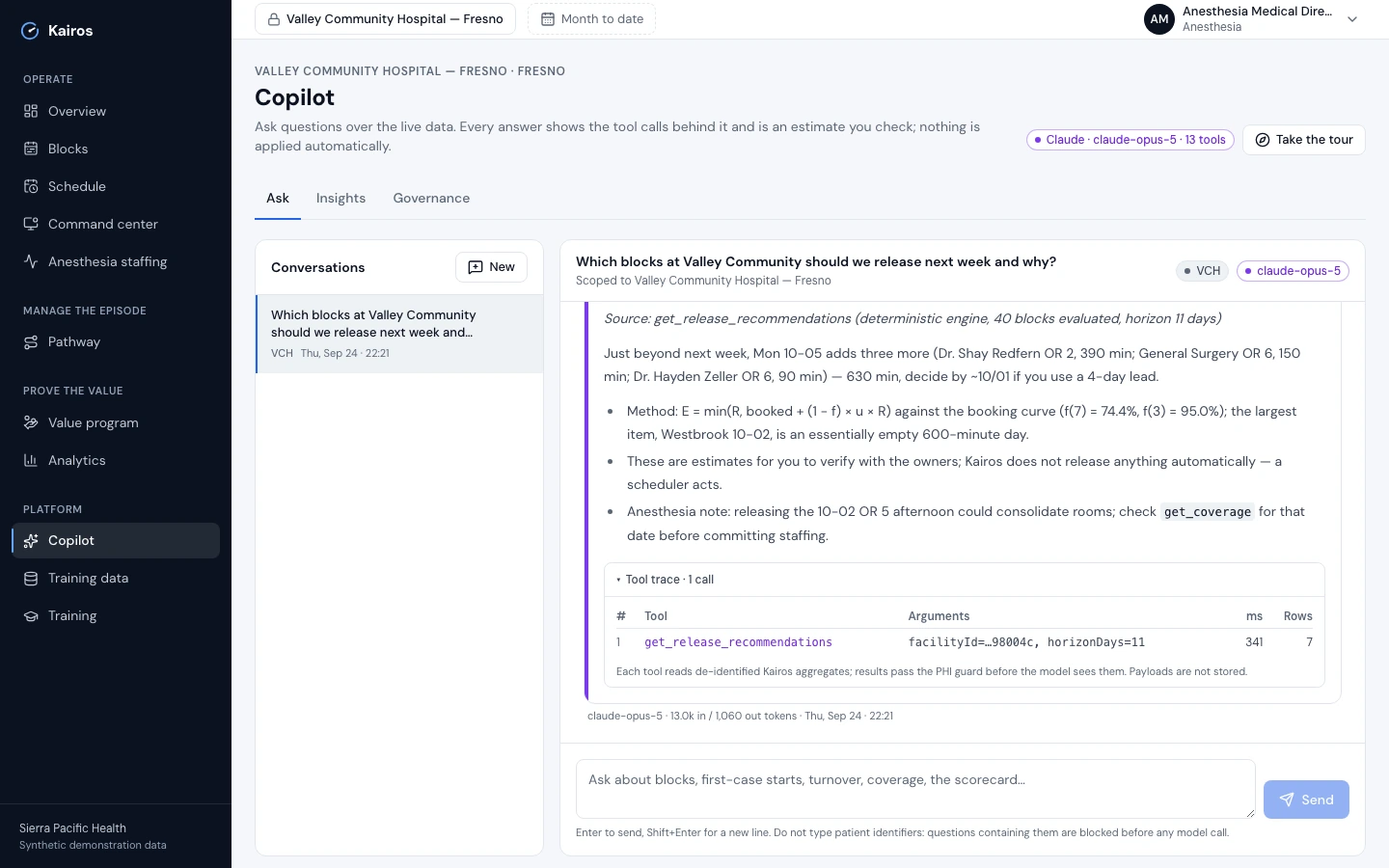
Copilot · AskAsked in plain English, answered from read-only tools over de-identified aggregates — violet marks machine-generated content.Copilot · Tool traceThe tool trace under every answer: which tool ran, with what arguments, how long it took and how many rows it returned.
De-identified only
A structural type and a guard on every outbound call block identifiers; a blocked call is logged.
Deterministic numbers
Predictions, recommendations, scorecards and savings are computed by engines; Claude explains, never computes a dollar.
Nothing auto-applied
Releasing a block, booking a case or validating a saving is always a person’s action.
Governed
Model inventory, intended use and human oversight per ISO/IEC 42001 and the NIST AI RMF.
Copilot, signed in as the anesthesia medical director, Valley Community Hospital, Sep 24, 2026; one question asked for this deck. AI governance: docs/AI-COPILOT.md and docs/COMPLIANCE-REGISTER.md (ISO/IEC 42001, NIST AI RMF). Demo script minutes 8.5–9.5.
Kairos (working name) · Discussion draft · September 2026 · Synthetic data only
The product · lever 5 of 5 · The training data underneath
11 / 19
A health system of synthetic data, rebuilt from one seed
45,271
surgical cases
18 months of history + six weeks booked ahead
837,937
rows across 48 tables
CSV or JSON export with a data dictionary
3 · 24
facilities · operating rooms
Two hospitals and an ASC, fictional
69 · 45
surgeons · anesthesia providers
Each with speed, estimate bias, persona
64 s
to regenerate everything
Seed 20260924, generator gen-1.1.0
45.7%
lower error than surgeon estimates
Best facility; all three clear the 30% target
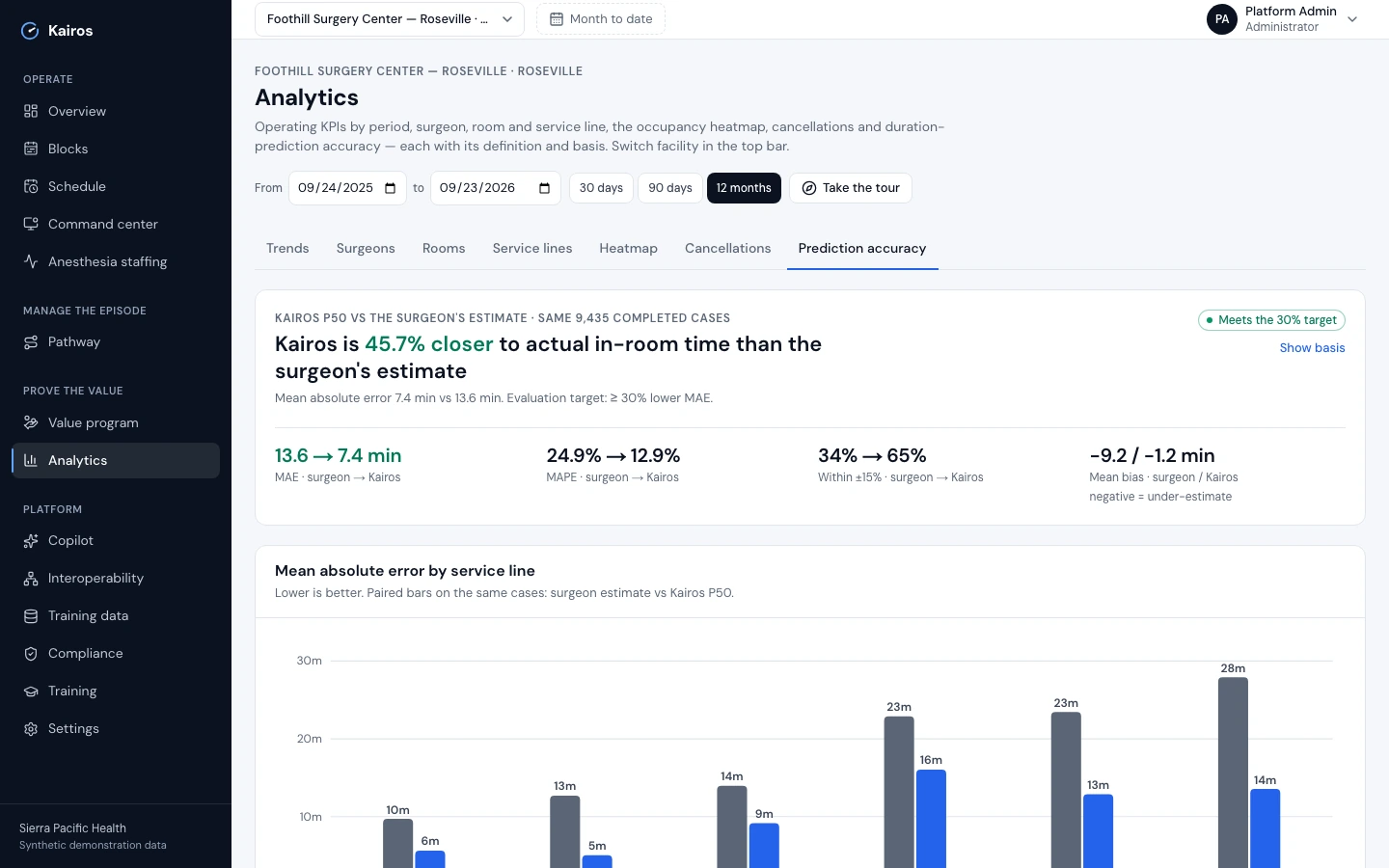
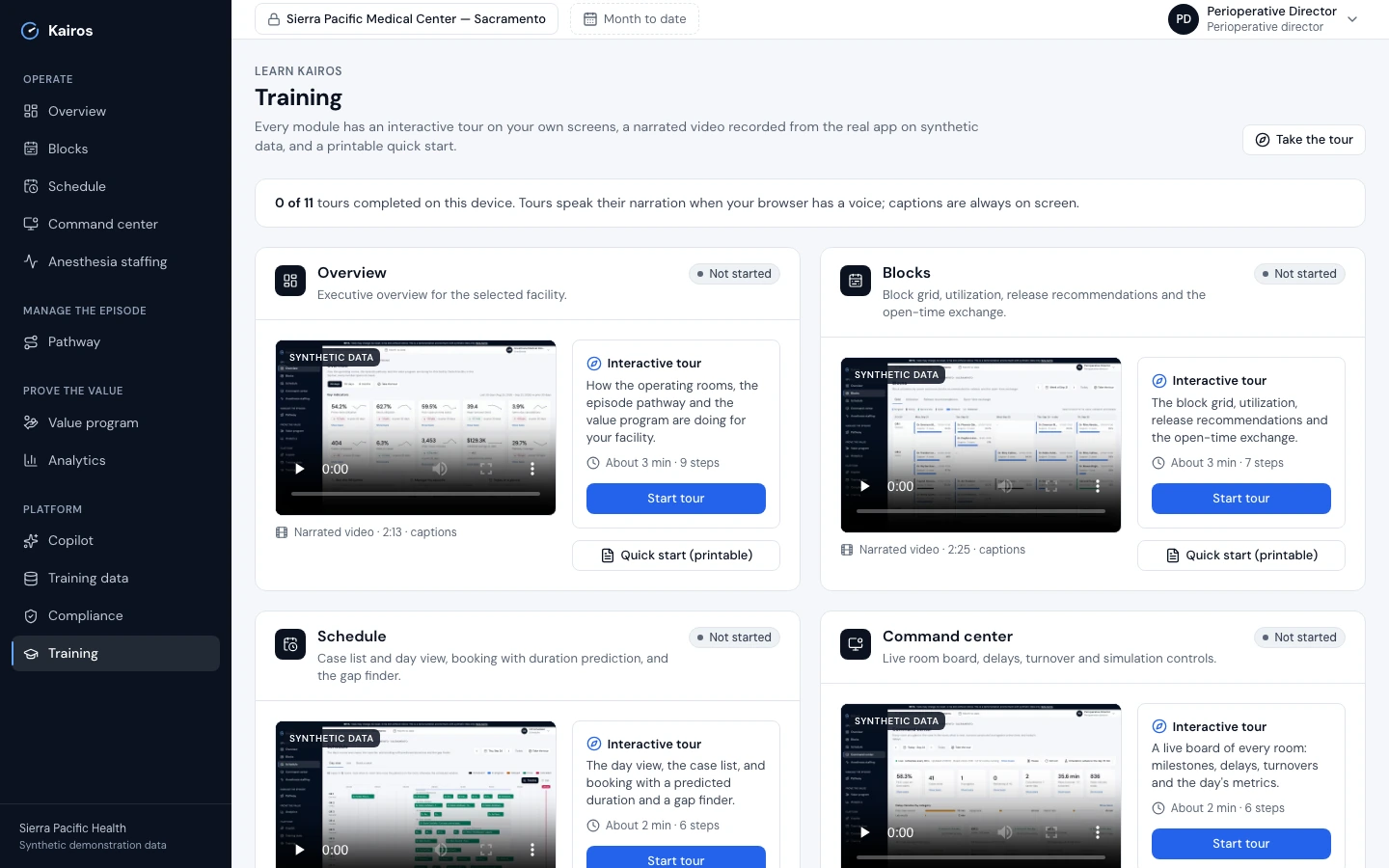
Analytics · Prediction accuracyKairos P50 versus the surgeon’s own estimate on the same completed cases, with the evaluation target shown.TrainingEvery module ships with an interactive tour, a narrated video recorded from the real app, and a printable quick start.
Training data → summary (gen-1.1.0, seed 20260924, generated Sep 25, 2026); Analytics → Prediction accuracy, trailing 12 months (Sep 24, 2025 – Sep 23, 2026), mean absolute error of Kairos P50 vs the surgeon's estimate on the same completed cases. Nothing is derived from real records (docs/TRAINING-DATA.md).
Kairos (working name) · Discussion draft · September 2026 · Synthetic data only
Proof from the synthetic pilot
12 / 19
Measured, gated, priced and explained — end to end
Valley Community Hospital (fictional) put orthopedics on the pathway on March 1, 2026. Everything below is computed by the platform’s engines from the synthetic dataset.
1.05
August 2026 composite score
Safety gate passed · 11 of 14 metrics at target · 134 episodes scored
18.31%
incentive earned, of base
Target 17.5%, cap 25% — 0 had the gate failed
45.7%
closer than surgeon estimates
42.4% and 31.5% at the other two facilities; target ≥ 30%
7,980 min
recommended for release, next 28 days
49 of 107 blocks at the pilot hospital
Five domains, August 2026 — risk-adjusted; the tick is target (1.00)
AccessProgressing
ReliabilityAt or above target
RecoveryProgressing
SafetyAt or above target
StewardshipAt or above target
$1.09M gross savings identified Mar–Sep across 10 categories and 84 ledger lines — led by length-of-stay days avoided ($353K), complications avoided ($237K), low-value tests avoided ($142K). $0 validated so far: no line counts until a clinician and then finance sign it off.
Baseline year → August 2026
Metric
Baseline
Aug 2026
First-case on-time starts
65.5%
85.3%
Low-value pre-op tests
36.7%
11.8%
Risk-adjusted LOS (O/E)
1.01
0.87
Opioid MME per inpatient case
261
155
30-day readmission
7.4%
4.2%
Synthetic, and honest about it. The generator builds a pathway effect into the pilot service line. These figures show that the engines measure it, gate it, price it and explain it correctly from end to end — they are not evidence that the pathway works. The pilot is where that evidence comes from.
Sources: Value program → Scorecard, Aug 2026, Valley Community Orthopedics pilot (synthetic). Analytics → Prediction accuracy, trailing 12 months (Sep 24, 2025 – Sep 23, 2026), mean absolute error of Kairos P50 vs the surgeon's estimate on the same completed cases. Blocks → Release recommendations, Valley Community Hospital, next 28 days as of Sep 24, 2026. Value program → Savings ledger, Mar 1 – Sep 23, 2026, all lines in draft. Metric pairs: August 2026 observed vs the program’s measured 12-month baseline (Mar 2025 – Feb 2026).
Kairos (working name) · Discussion draft · September 2026 · Synthetic data only
Built for hospitals from day one
13 / 19
Built to hospital standards — evidenced, not yet certified
Compliance · Register39 controls, 28 runtime evidence checks passing and 1 failing — shown, not hidden. Compliance is a live system, not a PDF.
HIPAA by design
Identifiers live only in an encrypted vault (AES-256-GCM); one service decrypts, and every decrypt is logged.
PostgreSQL row-level security: a query without a tenant returns no rows.
Append-only, hash-chained audit; the database refuses updates and deletes on it.
15-minute automatic logoff, lockout, break-glass access with review.
HIPAA and HITECH
Privacy, Security and Breach Notification Rules · implemented per NIST SP 800-66 r2
Anti-Kickback Statute, Stark Law and CMP gainsharing
OIG gainsharing safeguards
Designed & evidenced
Targets: HITRUST e1 readiness at pilot, i1 in year one; first SOC 2 Type II window after the pilot. WCAG 2.1 AA on every page.
Standards and status: docs/COMPLIANCE-REGISTER.md §1–3 and the public /compliance page. Control counts: Compliance page (admin), last evidence run Sep 24, 2026. No certification or audit has been performed.
Kairos (working name) · Discussion draft · September 2026 · Synthetic data only
Architecture at a glance
14 / 19
One API owns every rule; the AI sees de-identified aggregates only
1
Web — Next.js
A pure client of the API: no database, no secrets, httpOnly session cookie.
2
API — Spring Boot
Owns tenancy, roles, audit, encryption, the engines and every AI call; FHIR R4 façade.
3
PostgreSQL 16 with row-level security
No tenant set means no rows; identifiers encrypted in a vault; append-only, hash-chained audit.
4
Claude
De-identified aggregates only, checked on every call; tool traces stored; nothing auto-applied.
5
EHR connectors
FHIR R4, SMART Backend Services, Bulk Data and HL7 v2 SIU/ADT.
FHIR R4 + US Core
15 resource types served for read and search; everything exportable as FHIR, NDJSON or CSV.
HL7 v2 SIU / ADT
Scheduling feeds through the hospital’s integration engine create, update and cancel cases.
SMART Backend Services
System-to-system access to the EHR; vendor connectors await registration at the pilot site.
Infrastructure that scales
Containers across two availability zones, managed encrypted PostgreSQL, cross-region snapshots, keys in a cloud KMS.
Architecture: docs/ARCHITECTURE.md. Interoperability: docs/INTEROPERABILITY.md (15 FHIR R4 resource types in the live CapabilityStatement). Infrastructure: docs/DEPLOYMENT.md; the 99.9% availability figure is a design target, not a measured service level.
Kairos (working name) · Discussion draft · September 2026 · Synthetic data only
Commercial design
15 / 19
Gainsharing with safeguards — and a revenue model to agree together
The value program follows the clinical partner’s five-step gainsharing design; the software enforces the OIG safeguards so counsel reviews a method, not a promise.
1
Baseline
12 months per service line
2
Safeguards
Risk adjustment, exclusions, safety gate
3
Savings
Against an agreed counterfactual
4
Validated share
Only after clinical and finance review
5
Reinvest
Pathway staff, analytics, clinician incentives
Safety gate
Risk adjustment
No single-metric payment
Indicated-only stewardship
No payment without validation
Caps and a documented method
How Kairos earns — options for discussion Not decided
Option A · Platform subscription
An annual subscription per facility (tiered by operating rooms), covering the operations modules, the pathway, the value program, the copilot and support.
Option B · Subscription + success component
A lower subscription plus a defined, capped component tied to independently validated savings — only after the hospital’s own clinical and finance review.
Option C · Implementation
A one-time fee for the EHR connection, the 12-month baseline load and value-program set-up, alongside either option above.
Gainsharing steps: docs/PRODUCT-VISION.md. Safeguards as implemented: docs/VALUE-ENGINES.md §9. Revenue options are for discussion only — nothing is decided, and any success-based fee needs the same counsel review as the gainsharing design.
Kairos (working name) · Discussion draft · September 2026 · Synthetic data only
Pilot plan
16 / 19
One hospital, one service line, twelve months
Start at one small hospital with a high-volume elective service line, measurable variation and engaged surgeons. Multi-facility tenancy exists from day one, so the second hospital is configuration, not engineering.
Pilot phases, the clinical partner’s plan and what Kairos delivers
Phase
The clinical partner’s plan
Kairos delivers
0–90 days
Choose one service line; baseline metrics; map the workflow; define governance
Connect the OR schedule (HL7 v2 or FHIR); load 12 months of history; agree metric definitions, exclusions and safety thresholds; data-use agreement and legal review of the gainsharing design
Months 4–6
Build the pathway: pre-op triage, ERAS order sets, discharge planning
Pathway board live for the service line; risk screen at scheduling; testing-stewardship flags; release recommendations and open-time exchange; command center and anesthesia coverage
Months 7–12
Measure and refine: monthly dashboard, case review, validate savings
Monthly scorecard with the safety gate; savings through clinical and finance validation; compensation statements; CFO narrative; prediction-accuracy review
Year 2
Scale what works: add procedures, expand partners, introduce the incentive pool
Second service line and second hospital as configuration; multi-facility benchmarks; HITRUST i1 and SOC 2 Type II windows; incentive pool activated
What the pilot needs from the hospital
An HL7 v2 SIU feed or FHIR R4 access to the OR schedule
12 months of history for the baseline
Agreed metric definitions, exclusions and safety thresholds
A data-use agreement and business associate agreement
Counsel’s review of the gainsharing design
A clinical reviewer and a finance reviewer for validation
Phases: the clinical partner's twelve-month pilot, mapped to Kairos deliverables in docs/PRODUCT-VISION.md. Hospital requirements: docs/DEMO-SCRIPT.md talking points.
Kairos (working name) · Discussion draft · September 2026 · Synthetic data only
The partnership
17 / 19
Clinical credibility and the ability to build and run it
The founding team
Large-scale system build-out and healthcare experience
Builds and runs the platform: product, engineering, data and AI
The security, privacy and compliance program and its evidence
Cloud infrastructure, integration with the hospital’s EHR
Commercial operations and the path to certification
The clinical partner
An anesthesiologist who owns hospitals and clinics in California
OR-optimization expertise and the Farm to OR Table model
The pilot site, the service line and clinical governance
Metric definitions, protocols and case review with the team
Relationships into large hospital systems for year two
Together
Design the pilot and the value program, sit on its governance, and take a proven result to the large systems the clinical partner already knows.
To be agreed
Equity, funding, roles and governance of the company.
Roles as discussed; nothing here is a commitment. Names are intentionally omitted.
Kairos (working name) · Discussion draft · September 2026 · Synthetic data only
What exists today
18 / 19
A working platform, built in one intensive build cycle
14
modules, end to end
API, web, tests and docs for each
39
compliance controls
with runtime evidence checks
15
FHIR R4 resource types
plus HL7 v2 SIU/ADT ingest
13
narrated training videos
and 11 interactive tours
45,271
synthetic cases
regenerated from a seed in about a minute
Built and demonstrable
Overview
Blocks
Schedule
Command center
Anesthesia staffing
Pathway
Value program
Analytics
Copilot
Interoperability
Training data
Compliance
Training
Settings
Seven demo roles, three fictional facilities, multi-organization tenancy, a public site with security, privacy, terms and compliance disclosures.
Second iteration — before real patient data
Live EHR connectors at the pilot site (vendor registration, integration-engine feed)
Multi-factor sign-in required for anyone with patient-data access
Envelope encryption with managed keys for the identifier vault
A dedicated cloud account with full account-level logging and threat detection
Business associate agreement and zero-retention terms with the AI vendor
A named privacy officer and a tested incident exercise
Demo accounts removed; data-use agreement and a data-quality gate on real feeds
TrainingEvery module ships with a tour, a narrated video and a quick start.
Module list: the signed-in navigation. Counts: Compliance page, FHIR CapabilityStatement, training manifest, Training data summary. Before-real-data list: docs/RISK-REGISTER.md (actions due before the pilot) and docs/INTEROPERABILITY.md.
Kairos (working name) · Discussion draft · September 2026 · Synthetic data only
The ask · next steps
19 / 19
Five decisions to start the pilot
1
Agree the pilot site and service line
One hospital; one high-volume elective line with measurable variation and engaged surgeons.
2
Sign a data-use agreement
With a business associate agreement, before any real data moves.
3
Counsel reviews the gainsharing design
Anti-Kickback, Stark and CMP review of the value program — required before it can activate.
4
Open EHR access
An HL7 v2 SIU feed or FHIR R4 access, and 12 months of history for the baseline.
5
Decide the brand name
Kairos is a working name.
Kairos
Software organizes, measures and drafts; clinicians decide. Let’s prove it at one hospital.
Kairos is a working name for software in beta. Every product figure in this deck comes from a synthetic, fictional health system; none is a result at a real hospital. Market figures are as cited in the clinical partner’s framework. Kairos is not a medical device and does not provide medical, legal or financial advice. This deck is a discussion draft, not an offer of securities.
Kairos (working name) · Discussion draft · September 2026 · Synthetic data only